

The spec goes where the work gets built.
An approved story carries task, plan and context. Teklens hands it to your tool by link, opens it in the local checkout or starts a coding agent in an isolated environment. Branch, pull request and Jira link come back.
- Jira ticket TEK-418 with code context
- Linked stories & dependencies
- Estimate 6–8h, from the code
Context gets lost between the ticket and the editor. Whoever builds re-reads the spec, asks around and makes assumptions nobody approved.
- Copy the handover instruction with task, plan and context and use it in any agent.
- Open the ticket in the local checkout with Claude Code or Codex.
- Start Codex or OpenCode as a Teklens agent, with model choice per run.
- Follow progress, usage and result. Branch and pull request are linked in the Jira ticket.
How it works.
- 01
Prepare the handover
You pick the Jira ticket. Teklens assembles task, plan and context.
- 02
Choose the route
A link for your own agent, a local tool, or a Teklens agent in the sandbox.
- 03
Build
The agent works in the checkout or in the isolated environment and reads the context through the handover link.
- 04
Review the result
Branch and pull request are ready, the ticket shows the link. Implementation review checks the acceptance criteria.
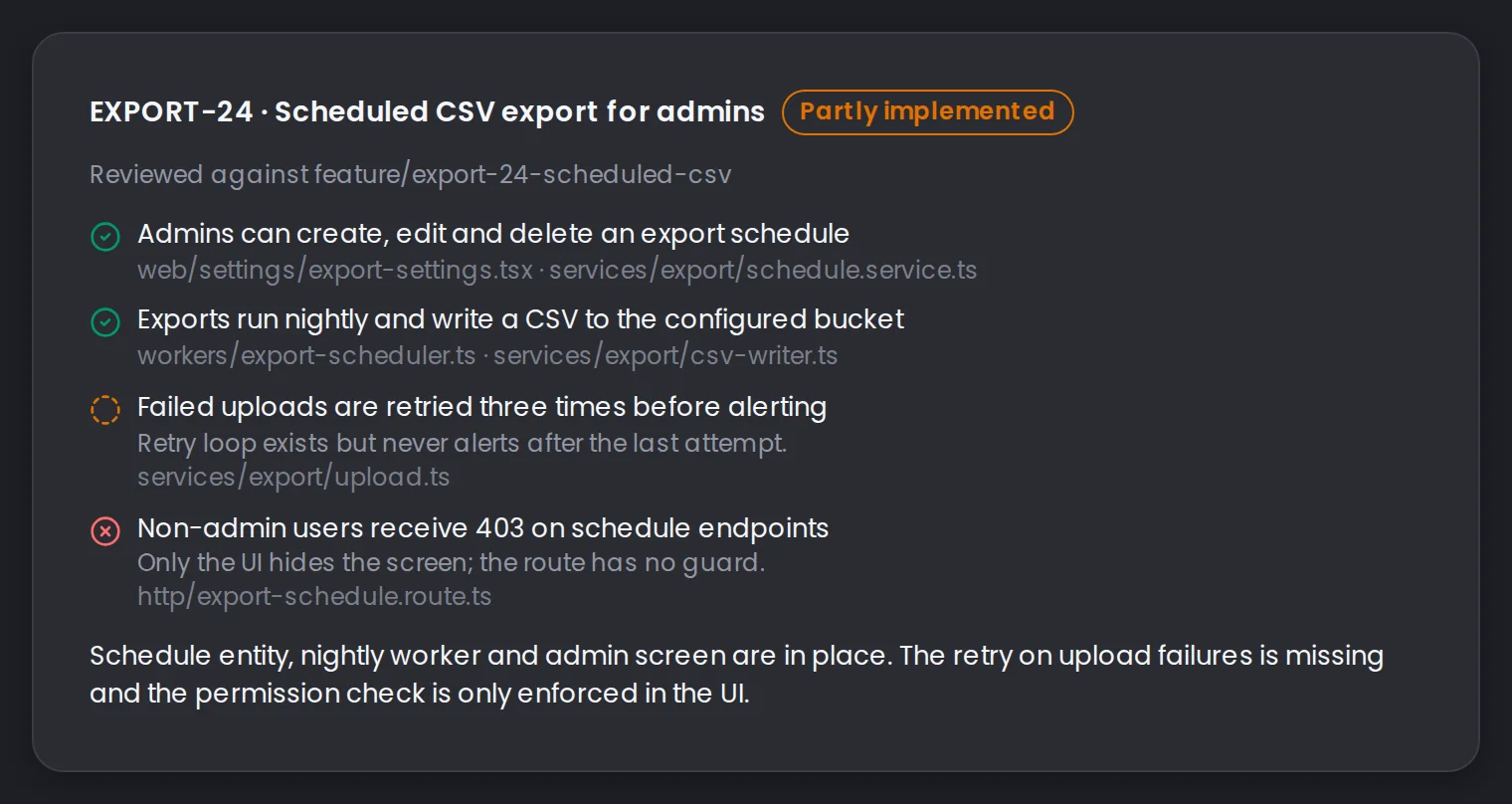
Implementation review per acceptance criterion, with the files involved.
One branch and one pull request per repository, linked in the Jira ticket.
Next: skills and playbook- Live for Codex and OpenCode as Teklens agents. Claude Code as a Teklens agent is coming.
- Open locally: Claude Code and Codex. Other tools through the handover instruction.
- Handover links expire and can be revoked.
How it fits together.
Less coordination work.
CPOs and CTOs align AI strategy, operating model and implementation. Product and engineering test the Product Brain with Jira and code. EUR 1,000 in test credits are included.
Two paths: set the direction or test Teklens on real product work.